June has been a blast. It's been a month of hanging out with family building memories on one of my favorite rivers, The Buffalo National River in Arkansas. The Ozarks are an awesome place to visit. We've made it a family tradition to return to Buffalo Point campground outside Yellville, AR since I was a boy. When I was child, we rented canoes but now we bring our own. This year the flotilla included 8 boats and ranged in age from 3-82. We floated from Dillards Ferry to Rush on Monday. The next day, the guys went fishing while most of the family stayed at camp and swam.
It was also the first time both of my girls paddled their own kayaks the entire trip. It's hard to explain the feeling but watching their confidence grow was tremendous. You can literally see them learning that they have the strength and capabilities to accomplish anything. In the beginning, they didn't venture too far but as the day progressed, I had to call out to my youngest to slow down and stay closer, which got me to thinking about another trip.
Of course I take my BNL fishing and he catches the biggest of the day...next time it's fly only!
Unfortunately, my oldest still refuses to camp on a gravel bar. She isn't scared but at this point still requires modern facilities. However, the little one was super excited about going. In fact, after I mentioned it she reminded me on a regular basis so I would not forget.
I had to take advantage of her eagerness before she had time to really think about it. My oldest was attending a week long camp with her Girl Scout troop which provided the perfect opportunity. After dropping my oldest off at camp we spent the next three days kayak camping on the Buffalo.
The first day went by pretty quickly. We didn't get on the river until after lunch. The entire float I had planned could easily be done in a day but I wanted to be sure we had time for fun and time to learn. It would take us three days to go 8 miles.
The first thing we talked about was safety. We've had the pfd conversation but I went into more detail about keeping up with her paddle, any gear she needed for the trip and especially making sure she secured her kayak when she wasn't in it. We talked about suitable locations for camping on a river including never camping at the base of a cliff and planning an escape route if needed.
We also worked on paddling skills. We would run a shoal and I would pull her kayak back to the top and have her do it again. Only this time with a goal or task in mind. And when she lost her balance and fell out of her kayak, she had to re-renter it from the water. All of this was done in between ample amounts of swimming, skipping rocks and exploring the area.
Wasn't planning on a re-entry lesson but couldn't pass up the opportunity.
Again I was struck by how quickly her confidence grew. The second morning while I was breaking camp, she put on her pfd, pulled her kayak off the shore and paddled across the river to a nearby creek. That got my attention because I hadn't scouted that creek yet and tried to check new areas for snakes and wildlife before she ventured into them.
I didn't want to restrict her or make her feel any sense of danger so I just waited to see what she did. We had spoken about being aware of the surroundings, particularly where she stepped and what she grabbed so I wasn't too concerned. When she backed away from the creek and came back to camp, I knew she was making good decisions. She had something she wanted to show me so we packed up quickly and made our way to that creek.
The diminishing glow of a fading sun marked the end of our trip. The next morning we paddled the last mile. I watched as she ran the last few shoals on her own, often going before me.
I remember the last shoal very well. The channel cuts close to the rock lined bank on the right side with a tree hanging about 4ft over the water with just enough space between the branches to make it under them if you can maintain your course. At the bottom there are several large boulders that force you to cross the flow and get to the left side or crash into them. For an experienced paddler it's nothing special. But for a beginner, it could be intimidating. I ran it first to show her the way. When I turned around she was passing between the branches of the tree, crossed to the left side and shot past me before eddying out behind the boulders. Show off!
As a stay-at-home dad of two girls, I’ve played my part in
many a tea party. I’ve judged dress-up
contests, dance competitions, possibly participated in 1 or five…but I’ll never
admit it. Sadly, I’ve learned what a wet
brush is and how to use it. So imagine how
excited I was when their JK Skippers arrived last weekend.
We went out three afternoons last week. Each trip, I watched as their confidence
grew. The first afternoon they stayed
relatively close and didn’t venture far from my kayak. In fact, it was like playing bumper boats
most of the afternoon. We focused on learning the fundamentals, entering, exiting, stopping, turning, and maneuvering
the kayaks. Towards the end of day one
my oldest (9) was really getting confident.
I mentioned to her that the skippers were very stable and she might try
standing up. Just as she stood up, I
looked over and my youngest (7) was standing and paddling all over the
lake. She’s always been a daredevil and I
have to be careful what I say in front of her.
The afternoon ended with them standing in their kayaks and beaming with confidence.
The next day I awoke to, “daddy can we go kayaking today?” Such a relief from the normal, “can we turn
on cartoons.” I jumped out of bed and we
were on our way before either could change their minds. The confidence they had built the day before
was still growing. Each was ready to hit
the water before I could get my kayak off the truck rack.
My oldest grabbed her kayak and drug it to
the water. Put on her PFD and asked, if
she could get in the water. Of course my
youngest wasn’t about to be left behind.
I watched as they were able to drag their kayaks to the water and get
into them without any assistance. I was
pretty excited that each was comfortable enough to get in the water without me. I took my time and let them explore the surrounding
area on their own.
When I finally got my kayak in the water they were ready to
explore. We set out a quarter mile trek
that ended at an island perfect for swimming and collecting shells. I anchored my kayak under the shade of a
cypress tree and watched as they paddled and swam around the island collecting
shells most of the afternoon.
On the way home that evening, they asked if we could come
back the next day. Of course, I’d do
anything to avoid having my finder nails painted! Our third trip, we really ventured out. We paddled nearly a mile of open water to a
distant island looking for wildlife. Frequent swim breaks were required along the way to cool off from the heat of the day. I was super impressed at how quickly they had
progressed. At every break, I would
watch as they would stow their paddles and secure their kayaks. I had made a point to talk to them about the
danger of losing a paddle or worse their kayak.
The same lessons my dad had taught me over 30 years ago. At the end of day three they could manage
their kayaks on their own. They were
taking responsibility for their gear and their safety. They were learning and I was proud.
In just a few days, we’ve learned that kayaking is a lot of fun
but it also builds confidence, teaches responsibility, requires planning, and is
great exercise. As a parent these are just a few of
many important skills I want my girls to learn.
In a week, they'll start back to school and summer will effectively be
over, but our fun is just beginning.
Ever have a bad experience and questioned how you ended up in it? I recently got caught in a storm while kayaking in Felsenthal National Wildlife Refuge. I was unable to get off the water before the storm hit. As I was sheltering at the base of a tree and lightening was crackling all around me, I questioned how I ended up in it.
Felsenthal NWR a 65,000-acre wildlife enthusiast's playground. If getting "off-the-grid" is what you seek this is the place for you. No cell phone service, limited public access, no homes, no ranger stations. It's a maze of sloughs, swamps, lakes, rivers, creeks and lowland bottoms. It's called a "refuge" because there is little to no human contact or development once you're out there.
Video of the event
Last week I ran into a large group of big gar in the refuge. Of course I caught a small one. I watched as a huge gar followed but rejected my offering, leaving me with a bad case of gar fever. I spent the better part of Saturday afternoon researching gar flies then tying a few for Sunday's trip.
The weather has been sketchy around here for a day or two. Occasionally a storm will blow up and run its course quickly. I knew the chances of a small storm existed when I drove to the launch Sunday afternoon. In fact, I turned around at the launch and drove 8 miles back to the highway because I hadn't checked the latest forecast. Good news, nothing was showing on the radar and the hourly forecast suggested a small chance of rain around 6 pm leaving me 5 hours to fish, worst case.
Waiting it out
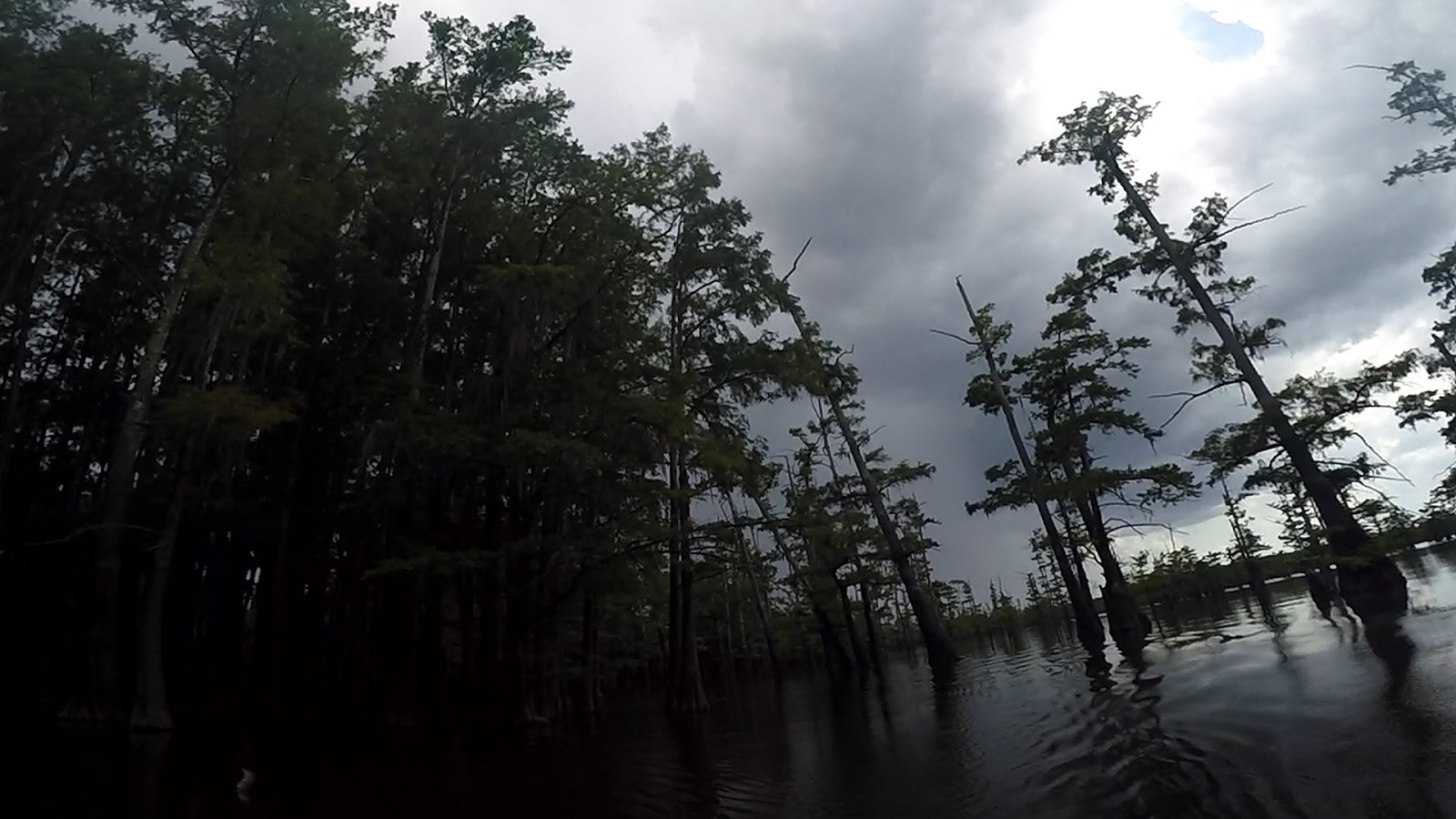
It took about an hour to paddle the 3 miles to the area I knew held gar. They were still there and popping on top. I hooked several, including a 4 footer, but landed none. Ironically, I was thinking this blog post would center around the challenge of catching gar on the fly. In the excitement, I didn't notice how the clouds began to change (the video shows a clear change) around 4:30 pm. At 5 pm, I heard the thunder and realized I was in trouble. I was an hours paddle away in good conditions...
Early afternoon well before thunderstorm
The conditions went bad quickly. A strong southern wind hit me first. It was cool and refreshing in the 95F temperature. I welcomed it and secretly thought it might aid in my return. It was at my back as I was paddling north. It didn't last. A moment later and a strong northern wind slowed my progress. The water got choppy and I was now paddling into a 15-20 mph headwind. The cypress trees were swaying back and forth. I was wearing a self-inflatable pfd. Meaning you have to be conscious to activate it. I started worrying about being knocked unconscious from a falling tree branch. I made a make shift auto inflate pull from my dog leash by attaching it to the lever and locking it. If I was knocked out of the kayak the hope was the dog leash would activate the pfd. I'm in trouble...
Looking south, clear sky at 4 pm
Looking same direction as above, clouds building ~4:30. All I saw was the gar pop on top.
Looking north, clouds building ~4:30 pm
I was about half way when I saw a cloud to ground lightning strike. I'm not going to make it. It was time to find refuge. I pulled up on a small island and took shelter below a small cluster of trees. The lightning grew more intense. It was all around me. Then a explosion sent me to the ground. My ears were ringing as a lightening strike had been really close. I needed a plan. I had no idea how long it would last, so at the first lull in the storm I jumped back in the kayak and made a break for it. It wasn't meant to be...
Not going to out run this. Trouble at 5:15. The lightning started soon after and I left the water
The lightning continued. The wind picked back up. I crossed the refuge and beached the kayak. It would be safer to run out than paddle out. I've completed 9 marathons, I run regularly, but I've never run that hard. My lungs felt like they were bleeding, the burning was deep inside. I didn't stop or slow down.
The line from upper right corner to lower left corner passed over me. Got out just in time.
It was a good decision. Weathering the storm would have been a mistake. It lasted 3 hours. I returned and made my way back to my kayak once the lightning stopped. During those hours and over the following day, I had time to think about my situation. Here's what I came up with.
Pro's or what I think I did right:
Float plan:
Let someone know where you're going. I sent a text to my wife with my launch location. I was confident she would have alerted someone if I didn't return that night. She has done as much before.
Stay calm:
In any stressful situation one of the most important things you can do is remain calm and stay in control of your emotions. I could have freaked out and paddled like crazy through the storm. However, I've heard more stories of people being killed on the water trying to out run a storm then people who sheltered and waited for it to pass.
Evaluate the risk:
I went out knowing there was a risk of thunderstorms during the afternoon. I checked several times before getting on the water. Later, as the storm ran its course I had to re-evaluate the risk of staying or moving. Eventually I decided to move and run out during a brief break in the lightning. The storm seemed to be growing and I could hear more thunder in the distance.
Keep thinking, evaluating, and adjusting:
The situation was very fluid. In the beginning, I though I was going to make it back to my truck. When the lightning started I knew I needed to find shelter and get off the water. I wanted to be on dry ground. Not on the water sheltering under a giant tree that might fall on me or be a lightning magnet. There are large trees all over the refuge that were obviously struck by lightning. Finding hard ground in the refuge is not easy. Being familiar with the area was a huge benefit and I'll talk about that next. As time passed I sensed this storm wasn't going to pass quickly. It wasn't a summer storm like I had hoped. But there were waves and after each was a small opening. After 40 minutes in the storm I decided to move during one of these openings. Again, the situation was fluid. The opening I choose didn't last long enough for me to get back. However, I was now close enough to leave the kayak and run out. It was both quicker and safer to run than paddle. Again, knowing the area was huge!
Know the area:
Like I mentioned earlier, being familiar with the area was really important. First because it helped me get back safely. Secondly, not feeling lost and being confident on my location reduced stress in a stressful environment. It made it possible to keep moving in the storm. Even if you're not on home water you should always take note of prominent landmarks. You never know if you'll need them later.
Shoes:
I stopped wearing flip flops on the water 2 years ago. Primarily because I do a lot of solo kayaking and felt like if I ever found myself in a bad situation I'd want real footwear. I was happy I had shoes on when I was running through the refuge.
Cons or things I know I did wrong:
Gear:
A weather radio would have been helpful but I'm confident I could have avoided the situation. More on that next.
Also, in my opinion a manual inflatable PFD isn't ideal in a storm. When the winds kicked up to 20 mph the trees started swaying and cracking All those downed trees I saw as bass habitat, I had a different picture in my head now. Being hit by a falling tree or branch and knocked unconscious became a real concern. I'll keep a traditional PFD in my kayak in the future.
I didn't have any foul weather gear. A simple rain suit would have made things more comfortable when the temperature dropped to 73f.
Pay attention to your surroundings:
Being honest, I got fish brain and it cost me. I failed to notice the clouds changing in the distance (sequence of pics above show the change). Looking at the video there was an obvious change in the weather. If I had paid more attention to the conditions I would have been closer to the boat ramp when I heard the thunder and ultimately off the water before the storm.
Over rate your abilities:
No matter how confident you are in your kayaking abilities you will never out run a storm. Don't let your mind convince you otherwise. I was sure I could get back even after I saw it bearing down on me. In fact, I hesitated and questioned if the storm was moving in my direction or going to be a near miss. If you can see it, start moving to safety, and move with a purpose. Lesson learned, the hard way.
That's all. Hope some of this helps someone avoid repeating my experience. It wasn't fun.
I've gotten some "random" comments about posting fishy related material on the internet. A few were very, passionate, and accused me of destroying the "wonder" of the "natural world". I won't repeat the comments b/c it won't create a positive environment or intelligent conversation. Plus, internet spats are just sad.
However, I will explain why I disagree and feel like posting is a good thing. I created this blog to share my love of the outdoors, and more importantly, to protect the "wonder" of the "natural world". Not to brag, or self promote.
For years, I practiced the, don't share attitude. But decided that philosophy doesn't work b/c it doesn't create any value or stakeholders. I'm still vague on the locations, but that's b/c I don't want to be fishing beside 100 of my closest friends. Not, b/c I feel like it's hurting the fishery. Rather, in my opinion the fisheries are being hurt by poorly educated anglers and a few bad apples. We need more people with a vested interested in the fisheries and outdoors in general. I hope my posts encourage others to get outside and experience these "wonders". And in return, keep a watchful eye over these treasures and protect them for future generations.
I post to create awareness and hopefully some value. Organizations like, Trout Unlimited (TU), Orvis, The Missouri Smallmouth Alliance (MSA) and many others, have learned that creating and promoting the beauty of the outdoors does more good than harm. Creating value for people will build a community with a common goal...protect the resources we find most valuable. There is strength in numbers. Not convinced, check out this video from TU, Chris Wood speech.
Further, I recommend wearing a PFD, safe fish handling practices, catch and release, or responsible harvesting (nothing wrong with catch and keep), and leave no trace camping. Fishing from a kayak is also better for the environment and has some obvious health benefits.
I feel like we need to get more people kayaking, camping, enjoying the environment, and fishing in general...anything outside! In my opinion, more people loving and protecting the "natural world" is a good thing.
Below are a few links to visit and learn how promoting the outdoors creates value and protects the resources. If you know of others plz post in the comments. More awareness is a good thing.
Winter time paddling brings along additional risks that should be taken seriously. Winter trips mean paddling in cold weather, on cold water, and most times miles away from help. If you're going out on the water you need to be prepared for the inevitable - taking the spill. Not being prepared can cost you your life. Don't plan on being lucky...it'll bite you in the a$$.
There are enough articles out there on winter clothing, wearing proper attire, dressing in layers, etc. So I'm not going to cover what's already available. Rather, what happens after you end up in the drink. Either from a spill out of your kayak or maybe loss of balance while wading in a river. However you end up in the water, the situation just became serious, and could become an emergency if not handled properly.
Don't plan on paddling out if you take a good spill. You'll quickly lose the ability to make good decisions, your balance will be jeopardized, basic motor skills will be compromised...simple functions like gripping a paddle may become impossible. Be aware the body shuts down when its cold, wet, and borderline hypothermic. As blood leaves the extremities, your ability to stand or walk will become difficult. This can all happen in minutes.
Lets not make it complicated. The basic need is to get warm and can be accomplished with a change of clothes and the ability to make a fire. I pack a dry bag with a pair of ski bibs, thermal top and bottoms, gloves, hoodie, socks/liner, and jacket. I place those items in first.
Followed by a first aid kit, fire starter/matches, and fire log on top. These are the 1st items I might need. I use a clear dry bag so I can visually inspect everything before I get started. The dry bag goes in the hull of my kayak...and it doesn't come out very often. It's a small pack b/c I keep my trips shorter in the winter for obvious safety reasons.
A fire is a sure way to improve the situation and get the brain back on task
If you end up cold and wet. Stay calm and think through your situation. If you're not far from the take out....maybe just a change of clothes will do. If you're further and afraid you might end up wet again...strip off the wet, put on the dry, and build a fire to dry your wet clothes. Every situation is unique, so you'll have to keep your wits and make a decision. You'll be amazed how quickly fear turns to terror when you're alone, cold, and wet...getting warm is key...don't become a statistic!
This is not an all-inclusive list by any means. There are some other obvious safety tips, like going with a buddy, making a float plan, carrying a cell phone, etc...but these all rely on others helping you. Be prepared to take care of yourself, at least in the beginning. The above is what I feel comfortable with assessing my own skills and paddling locations. You need to make your own assessment and plan accordingly. Be safe.
Jeff Malott at, Yak Fish Arkansas, contacted me over the weekend and asked if I minded providing some kayak launch locations in SE Arkansas. Jeff is building a comprehensive list of kayak launches for Arkansas to be included in a new website, http://arkansaskayakfisherman.com. Be sure to check out both for some great information about yak fishing in the Natural State.
Here's a map of some launches I have posted on my blog. It'll get lost in traffic over time, so it's paged at the top. It's a work in progress so check back for new locations. If you're traveling this way and want additional info just pm me and I'll help anyway I can.
Had a few hours today, Friday, so I decided to try the water trail access at Shallow Lake. It's about 30 additional minutes from my house and having never been I wasn't familiar with the area or specifically the fishing. But, the only way to learn is to get out and get paddling.
Signs always help!
Found the sign but didn't really follow the suggested path. It headed North and I followed that general direction but I was mostly lookn for fishy places to wet a line. Found a few, and caught a few bass.
The area is changing from Summer to Fall. Temps are lower, 65 this morning at the ramp, and leaves are beginning to change colors.
The refuges inhabitants are becoming more active...saw a few turkeys, 2 deer, and the bass are starting to school up...caught this one and had 3 follow it back to the yak. If I had been fishing anything with more hooks I would have had a double on the same bait...haven't done that since I was a kid.
Only had a few hours to fish but I managed 3 and lost 2 so not bad for 3 hours of fishing. I'll be back to really test the fishing shortly, it seemed to have a ton of possibilities, deep water, pads, and cypress.
Part of the water trail
Entrance to Fishtrap lake part of the water trail
Hut with a view
When I got home I did a little more research and found this, with maps of 2 water trails: